To travel down a bustling city sidewalk and hear church bells is to be pulled into the past; As if to say, “This time is GODLESS, but at least we have each other.”
Category: Miscellany
The outlet of Nostos Nic: Uncategorized Creative, to include all that doesn’t neatly fit into Historical Meandering and Musical Mining, namely things of a strictly photographic, philosophical, literary or poetic nature.
Jack on Jazz: How A Genre of Music Helped Create a Genre of Literature
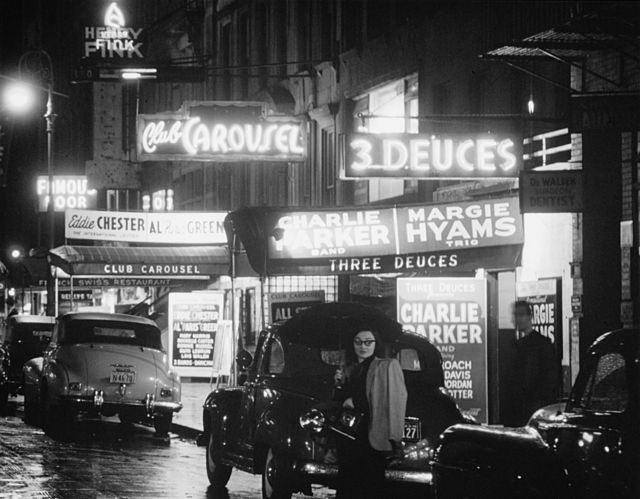
While cruising across the Bay Bridge to San Ramon about a month ago, I caught a Michael Krasny interview with Marcus Shelby on NPR. Marcus Shelby–teacher, composer, bassist–is the heartbeat of the Bay Area contemporary jazz community. His deep-rooted understanding of African-American history is seen through his performance of songs such as “Harriet Tubman” and “Port Chicago,” which he uses as an exercise of cultural remembrance. The show aired on Duke Ellington’s birthday, and, after discussing the Duke’s influence, Shelby found himself awash in much deserved praise as Krasny opened the phone lines and caller after caller paid their respects. Then a caller asked him for guidance. This woman, whose name escapes me, had always appreciated, but found it hard to like, jazz, and she asked Shelby for advice on learning to love the art he had so skillfully mastered. Shelby immediately recommended Kind of Blue by Miles Davis.
Kind of Blue is a special kind of album–as approachable as it is quixotic, as revelatory as it is confounding. It might be difficult for modern listeners to understand the revolutionary concepts burned into the album’s grooves since we’re so far removed from its August 1959 debut. Since then, this type of jazz has been emulated the world over, and is now an accepted part of the American unconscious, present in our lives as music in movies and cartoons, and as the background to conversations in an elevator. But in 1959, jazz–particularly the form Davis pioneered here–was the cool subterranean art form that attracted hipsters like Jack Kerouac as well as traditional music mavens. Eventually it would transform popular culture in tandem with other revolutionary movements that prioritized spontaneity and emphasized the newness of roads less traveled.
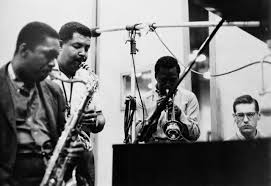
In studying art, I’m consistently impressed with how much preparation is involved in the construction of spontaneity. It’s not a false concept, but spontaneity does require skillful and thoughtful craftsmanship in order to result in artistic genius. Before hitting the studio for his Kind of Blue sessions, Miles Davis had been experimenting with “modal” jazz which emphasized soloists over a background of one or two scales, or “modes”, instead of what jazz typically emphasized–busy chord progressions. With a few compositional sketches in hand, he gathered a group of young innovators to round out his crew: John Coltrane as tenor saxophonist, Julian “Cannonball” Adderley as alto saxophonist, Bill Evans and Wynton Kelly on piano, Paul Chambers on bass, and Jimmy Cobb on the kit.
As this group of musicians entered the studio, Davis laid out the parameters: the focus would be on first takes. Beginning with the opening track, the tone is set for the album as Chambers takes the lead while Evans keeps us engaged with unorthodox chords from which the rest of the music takes its cue. This is a bold choice, leading with the bassist and refusing to follow a linear path, one that validates the song’s title, “So What”–a musical call to arms in its brash repudiation of the jazz norm, and a sign of what’s to follow. “Freddie Freeloader,” actually the first track recorded during the 1959 sessions, momentously extends the swinging vibe of the first track and beautifully showcases Kelly’s contribution to Davis’ sextet. For me, the album is weighted in the center with “Blue in Green”, a song aching with simmering mood. Often described as “meditative” by jazz pundits and music theorists, the cycle of chords for this song was hashed out years before entering the studio when Davis slipped Bill Evans a piece of paper. Having written the musical equivalent for “G minor” and “A augmented” on the note, he told Evans, “See what you can do with this.” “Blue in Green” was born. This song is noirified, sultry and conjures so many clichés: dimly lit boudoirs in black and white, smoke curling around a billowing curtain, and the butt of a cigarette falling, wasted, onto a dampened empty sidewalk as its user turns away into the night.
As with all game-changing works, Kind of Blue struck a chord with an audience ripe for its message. Postwar America was searching for an identity in the 1950s as the country was entering the Cold War. Living under the perpetual threat of annihilation, much of American culture proverbially stuck its head in the sand. Families proliferated, moved to the suburbs in search of a Leave-It-To-Beaver lifestyle, and focused on the acquisition of goods and services pushed by advertising agencies in magazines and on television. There was, however, a subset of the population that remained disaffected by the Second World War–so much so that they found it impossible to distract themselves with taglines, products and the promise of a glittering American life.
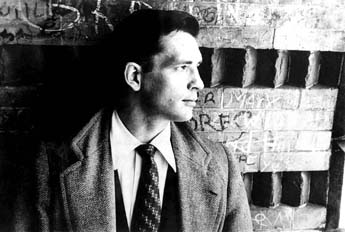
Individuals in the subset I speak of were young, and they were Beat. To quote the author Jack Kerouac:
“The Beat Generation…was a vision that we had, John Clellon Holmes and I, and Allen Ginsberg…of a generation of crazy, illuminated hipsters suddenly rising and roaming America, serious, bumming and hitchhiking everywhere, ragged, beatific, beautiful in an ugly graceful new way–a vision gleaned from the way we had heard the word ‘beat’ spoken on streetcorners on Times Square and in the Village, in other cities in the downtown city night of postwar America–beat, meaning down and out but full of intense conviction…it meant characters of a special spirituality who didn’t gang up but were solitary Bartlebies staring out the dead wall window of our civilization–the subterranean heroes who’d finally turned from the ‘freedom’ machine of the West and were taking drugs, digging bop, having flashes of insight, experiencing the ‘derangement of the senses,’ talking strange, being poor and glad, prophesying a new style for American culture, a new style (we thought), a new incantation…”
Kerouac was a sensory addict, a lover of music who frequented hot jazz clubs in New York’s Harlem and San Francisco’s Fillmore Districts. He would write perhaps the best known Beat novel, and for this reason he became “King of the Beats”–the unofficial Beat mascot as identified by the mainstream press. This Beat novel was liberally autobiographical, called On The Road, and provided insight into a subterranean community that shunned traditional society in searching for more authentic experiences; it emphasized spontaneity and a new mode of literary thought, just like Davis’ Kind of Blue. Published in 1957, it follows the misadventures of Sal Paradise (Jack Kerouac) and the classic anti-hero Dean Moriarty (Neal Cassady) as they mine for meaning in the American miles between San Francisco and New York City. The pair immerse themselves in the urban bowels of these two cities, where a simmering counterculture is on the brink of a full-blown boil in the late 1940s and early 1950s.
When Viking finally found the cojones to publish this epic novel, Kerouac’s importance as a postwar author was immediately evident not just for the content of his narrative prose but also for his method of delivery. As explained in his quote above, the concept of “Beat” was a communal creation based on existing concepts so, in that respect, the source of the novel’s message did’t make his literary voice unique. What did elevate his prose above that of his peers’ was a narrative style that Allen Ginsberg later termed “spontaneous bop prosody.” This style was heavily influenced by his Canuck heritage that blended French with English, his second language, but was most evidently the product of converting jazz cadences into phonetic words and complex sentence structures. The tempo of Kerouac’s writing embodied the frenetic force behind his perpetual travels–the movements that found him the figures who would inspire his content. As jazz was and is peculiarly American, his passion for the genre and its integration into his writing lent his words a unique force that paired perfectly with the rusted red, white, and blue landscape he so painstakingly painted, as well as the avant-garde characters he knew intimately and immortalized in fiction.
Just like the music of Miles Davis, Kerouac’s work was also predicated upon a “first take” ethos underwritten by a dedication to craft and persistent preparation. The problem with Kerouac scholarship is that his interviews were generally misleading, since he often drank rotgut booze to calm his nerves and enjoyed playing with his own mythology. Later interviews with the people he knew are also circumspect since they’re clearly self-interested and memory is a fuzzy, moving target–one that might be even fuzzier for a group of known drug users and jovial alcoholics. What we do know is that Kerouac told reporters he wrote On the Road in a three-week, benzydrine-driven “ball” on a single scroll of teletype; this news spread quickly, and remains a beloved creation story. Unfortunately for admirers of this myth, his official archive reveals multiple revisions of the famous novel that include wildly different characters and plot points written on traditional sheets of typewriter paper with his trusty Underwood or scrawled in his own hand. In fact, Kerouac spent most of his life obsessively developing his craft as he agonized over word choice, sentence construction, and character development. His “three-week ball” was actually the product of a lifetime of practice.
In addition, the novel would never have happened without a little help from his friends. Although a consummate devotee to the tedious work of writing, Kerouac was still searching for his literary voice which later combined a Wolfean narrative scope with the jazz constructs that dominated his journals long before he felt comfortable including them in published work. After years of approaching fiction traditionally by emulating the writers he most admired (Thomas Wolf, Ferdinand Celine), he unlocked the key to his success through an exercise called “sketching.” He came to this approach on the recommendation of Ed White, a friend who told Jack “sketch in the street like a painter, but with words” as a means to cure his stagnating depression. This allowed Kerouac to transcribe his “interior music” and gave him, as Joyce Johnson points out in The Voice Is All, “a way to write passages in which he could seize the peak moment of initial inspiration and ride it through to the end, without interrupting the flow of imagery.” This dissolved the “barrier between poetry and prose” that had frustrated him, and when Lucien Carr suggested Kerouac substitute a teletype roll for traditional sheets of paper, well, the last barrier to On the Road‘s writing was removed.
This understanding of events is directly contradicted by man historians, biographers and cultural critics point to a letter Cassady wrote to Kerouac in 1950 as the spark for On the Road in its current form. I believe that gives Kerouac short shrift and over-emphasizes Cassady’s influence on his writing. Sketching enabled Kerouac to release himself from “fiction and fear,” and helped to focus him on writing the truth with Neal Cassady, his muse, at the core of his entropic story. Writing Neal as he was instead of fictionalizing a Kerouac-Cassady hybrid for the main character, as he did in unpublished versions of novel, was the breakthrough he had resisted as a young writer struggling against an instinct to write from life when he believed the best writing was pure fiction. In the character of Dean Moriarty, Kerouac captured the reckless spontaneity used by Beat writers as an antidote to the numbness felt by a generation wasted in war, either dead on the battlefield or dying inside an over-regulated postwar society. Cassady may have been the essence of spontaneity, but it was the intrinsic freedom of Kerouac’s jazz-informed prose that enabled 1960s fee love and expression, and has continued to resonate with readers in successive generations.
I am one such member of those successive generations who found Kerouac as a teenager, and have loved him ever since. I read On the Road in high school on the recommendation of an English teacher, David Soltis, who was probably the greatest influence on my early aspirations to be a writer. I was instantly hooked, seduced by the realm of possibility inherent in Kerouac’s prose and drunk on his words like only a sheltered teen can be. I purchased every book on him or by him, and also collected recordings of Kerouac because to hear the author read his own words aloud beautifully reinforces the lyricism behind his craft. Although it would take me years to understand the import of Kerouac’s contribution to American culture, I immediately felt a connection with Kerouac’s restlessness. My teenage lust for this dead poet compelled me to wear a beret, write poetry that was bad but then got better, and reroute my family vacation to Lowell, Massachusetts so I could see Kerouac’s hometown and visit his grave.
This lust also drove me to jazz–straight into the arms of Miles Davis and his Kind of Blue, an album that continues to inspire me even while On the Road has, well, been relegated to role of a First Love. The novel’s lyricism and Kerouac’s devotion to craft continue to influence me as a writer and as an illuminated hipster hell-bent on preserving the magic of our disappearing American landscape. But as an adult woman I just can’t ignore the presence of sexism in his work (a topic for an entirely new article) or the perverse relationship between Kerouac and his mother–a relationship which ultimately formed his opinion of women as wives/mothers meant to be barefoot, pregnant, and subject to his will. This sexism taints his work form me as a 21st-century woman and writer in command of her own voice, but I still credit Kerouac’s role in my ongoing development as an artist, and, perhaps, even in my choice of men (also a topic for an entirely new article).
The Kerouac poster that hung next to my bed (next to the obligatory Leonardo DiCaprio and Brad Pitt posters) as a teen is long gone, but my vinyl copy of Kind of Blue is still a vital part of my record collection. And I’m not alone in this reverence; Kind of Blue continues to be the best-selling jazz record of all time, and is cited by many current artists–musical or otherwise–as an influence. First editions of On the Road sell for anywhere between $5,000 and $25,000, and it continues to be a contemporary pop culture presence with a movie adaptation that premiered in 2012. Teenagers will always want to read/listen to/wear something that is innately rebellious, and Kerouac will always fit that bill. Despite his many unsavory characteristics, I find myself reflecting on the last paragraph of On the Road time and time again–the one that explains his vision of America, his understanding of life:
“So in America when the sun goes down and I sit on the old broken down river pier watching the long, long skies over New Jersey and sense all that raw land that rolls in one unbelievable huge bulge over the West Coast, and all that road going, all the people dreaming in the immensity of it…and tonight the stars’ll be out, and don’t you know that God is Pooh Bear? the evening star must be drooping and shedding her sparkler dims on the prairie, which is just before the coming of complete night that blesses the earth, darkens all rivers, cups the peaks and folds the final shore in, and nobody, nobody knows what’s going to happen to anybody besides the forlorn rags of growing od, I think of Dean Moriarty, I even think of Old Dean Moriarty the father we never found, I think of Dean Moriarty.”
Kerouac lived by one credo: the voice is all. And when an evening of writing begins to fade away, in that moment just before the coming of complete night when I’m finishing articles like this or maybe jotting down a poem (or two), I think of Jack Kerouac, I think of the power of his prose and his ornery addiction to his craft, I think of Jack Kerouac.

He Did
I frequent the same coffee shop every morning on my way to work. This addiction means I’ve developed a rapport with the staff, particularly a young kid from Mexico City who has an earnest sweetness to him. This morning, the morning after Father’s Day, he asked me “Did you call your Dad this weekend?” I replied, with an uncomfortable chuckle, “Uh huh, no. I didn’t. My Dad’s dead,” as I scurried to the other end of the bar and away from the eager customer behind me, jonesing for java on a Monday morn. When I turned the same question on him he told me he didn’t know his father. Never did.
I bid him good day, and walked out to my car. Sliding into the driver seat of the VW my Dad posthumously purchased for me, I took a moment. I set my latte down, tossed my piece of illicit crumb cake onto the passneger seat, and rummaged for a CD from the glove compartment to realign my professional comportment. Fish, fish fish and found it–Anais Mitchell’s Young Man in America.
I forwarded through to Track 6, “He Did,” which accompanies this post in video form despite it delivering no video (not my preference, but it’ll do the job in a pinch). I default to music in times of (let’s say) stress without a second thought, as compulsory as an irregular heartbeat, because music makes memory move and marks moments; it heals through submersion since feelings felt fully are the ones that will eventually form a scab. While it probably made other customers uncomfortable, the exchange with my beloved barrista reminded me that while the void is very deep, still, in spite of passing years, at least there is a hole to fill. A path to find. A row to hoe. And an empty page to fill. It reminded me of how it feels to be my father’s daughter, alive like this.
For if nothing else, I am my father’s daughter.
Taking the Internet to Task
Let’s call a spade a spade. A writer’s promotion of his/her writing is an incredibly narcissistic act because it signals their belief that their opinions are worth merit, worth your time, worth a permanent place in type set into mankind’s artistic chronicle. “I am a delicate snowflake, here is my flurry; you’re welcome” could be the dedication of many books, particularly those of an autobiographical nature. That said, I am a reluctant blogger. As a freelance writer of the 21st-century it’s the best tool to expand my “brand” by showcasing my ability to use words good, defining my artistic eye and promoting my sense of music in conjunction with Twitter and Instagram. However, by expanding my online presence I’ve exposed my unique insights to copyright infringement and plagiarism I’ve not the resources to combat, and unintentionally invited internet creepers to send me emails in which they call me “Little Girlie” and ask to view and share lewd photos (a real thing that really happened). The internet is as disgusting as it is enlightening, as much a resource as is it a source for distraction and is also the ultimate manifestation of narcissism in many ways. Facebook, Foursquare, Google+, Path, Pinterest, SoundCloud, Tumblr, Vine: nobody is interesting enough to create and divide content on that many platforms.
Part of my beef with blogging is the preponderance of uneducated and uncritical posts. To clarify, I don’t use “uncritical” to mean lacking in criticism but rather to pinpoint synthetic contributions to the stream. Generating blank content such as uploading a photograph or inputting a quote without context or discussion only adds to the barrage of unexplained crap on the internet and serves as yet another superficial layer through which one must sift in order to find something worth reading or viewing. Too many sound-bytes, not enough polyphonic sound. Perhaps a more disturbing trend is the democratization of the role of critic. Whereas I’ve clearly benefited from this, I’ve also often said any asshole can have a blog, and in lieu of credentials many bloggers feel the need to savagely attack whatever it is they’re reviewing. Be it music, literature, art or movies, they break their subject down to build themselves up, mistakenly assuming a soap box and an authoritative tone produce the sum of a critique. I ask, for what purpose? I don’t want to read about an album or book that sucks, I want to be turned on to works that will give me chills and send me reeling onto the next thing inspired and engaged.
This opinion was solidified after watching a friend’s band solicit album reviews from music blogs. One such blog (which shall remain nameless) would review any band that paid them with writers who were “hired” merely because they left 100+ comments on the site. This band was given a review that was artless, cruel and untrue–that went through the album song by song to note why each one sucked, and gave no further information on the artist outside of that one album. In addition, the site made no mention that the review had been written in exchange for money. That is not a review, it’s an un-researched 3rd Grade essay without a hypothesis that conceals its ulterior motive. Clearly I’m biased towards and protective of my buddy’s band, but I’ve also reviewed albums semi-professionally and know a farce when I see it. This type of jury-rigged scholarship void of professionalism is described perfectly by Noam Chomsky in his observations on Twitter from the recent book Power Systems: “If you look at [tweets], they have a fairly consistent character. They give the impression of being something that someone just thought of…If you thought for two minutes, or if you had made the slight effort involved in looking up the topic, you wouldn’t have sent it.”
I’ve attempted to counteract (or at least not add to) these problems with this blog in a few ways. First, this site offers no paid content. Just as James Franco recently quantified his own process at a Commonwealth Club event in San Francisco, I merely attempt to understand certain forms of art through other forms of art–literature as an instrument of music, philosophy as a photographic lens, and so on and so forth–as a holistic approach to understanding my world, offering no answers merely unpaid observations. Second, I’ve added a brief biography in the margins to note an academic background and provide professional footing. While this makes me vulnerable to the aforementioned creeps, content written in anonymity engenders no confidence from the reader. If nothing else, I want my relationship with you, kind reader, to be genuine so the trade-off is worthwhile to me. Third, I do not write negative posts. The blogosphere and more traditional media outlets are already screaming with negativity and I see no need to turn up its volume; instead, I want to change the channel to something that has tickled my fancy and hopefully will do so to yours. At the core of this is the fact that I am neither a musician nor a filmmaker, not a baker, not a painter, and far be it for me to identify flaws in a song or a bundt cake I couldn’t dream of making.
Unchecked content, however, is not my only issue with the internet and its derivatives. In addition to his thoughts on Twitter in Power Systems, Chomsky talks of an “atomization” in today’s society. As we increasingly channel our efforts into online communities, our earth-bound relationships are suffering. We connect better with avatars than we do with the faces that sit beside us on the bus, and we are measured not by what we say in a job interview but by how well our LinkedIn account is formatted. Selfies have seemingly become more relevant and revelatory than the Self outside the computer, which is ironic considering the backbone of online communities is often anonymity as every Tom, Dick and Harry register blogs that thrive on sensationalism and unsupported facts. There’s a name for this: it’s called Yellow Journalism.
These fears are not my sole property. What technology is doing to us and has done to us is widely studied, and the dearth of reputable, intellectually stimulating content in popular culture is bemoaned by every generation from Lincoln’s time to our own. Perhaps it’s motivated by a fear of change, or maybe just the human tendency to bitch about our present because misery loves company. Whatever the reason, poets and scientists alike are fascinated by the fluctuating intricacies of human interaction–hence the writing of poetry, hence the practice of psychology (which are two sides of the same coin, really). The universality of the fears expressed in this piece became more real to me after reading the poem “Emerging” from Pablo Neruda’s Extravagaria (1974):
“A man says yes without knowing / how to decide even what the question is / and is caught up, and then is carried along / and never again escapes from his cocoon; / and that’s how we are, forever falling / into the deep well of other beings; / and one thread wraps itself around our necks, / another entwines a foot, and then it is impossible, / impossible to move except in the well— / nobody can rescue us from other people.
It seems as if we don’t known how to speak; / it seems as if there are words which escape, / which are missing, which have gone away and left us / to ourselves, tangled up in snares and threads.
And all at once, that’s it; we no longer know / what it’s all about, but we are deep inside it, / and now we will never see with the same eyes / as once we did when we were children playing. / Now these eyes are closed to us, / now our hands emerge from different arms.”
This, I suppose, is why I blog in the face of internet stalkers and the stigma of irresponsible blogging. Obviously, there are a plethora of brilliant bloggers and internet entrepreneurs who have used online tools to great effect, and have bettered the world because of it; thank goodness they were given the opportunities afforded by online marketplaces. This post is not meant to discount them, it is merely an attempt to offer my observations, state some of my fears and start a dialogue. For I fear binary numbers are usurping words, and the sterile future this fact implies is very scary to me. When we devalue the impact of words we shatter the importance of language as it’s used to communicate with members of our community–the one in which we move by day and not the one we fabricate by night while in the privacy of our shuttered homes. Anonymity afforded online breeds nothing good, and avatars with unspecified agendas hold no one accountable and bring nothing new to the table. In this vacuum of accountability, the social contract is subverted and we enter a realm fabricated from haphazardly connected content that does not foster ingenuity, which is the product of shared ideas of merit. Instead, it often leads to bickering fueled by a neoliberal obsession with profit in its most potent forms: fame or fortune. God, who’d want to be, God who’d want to be such an asshole.
So…my name is Nicole Meldahl, this is my blog and I wrote this piece while listening to “Bukowski” by Modest Mouse. Discuss.
Ghosts in the Radio

Three years ago today, I buried my father. I flew south through a lightning storm only my father could conjure on the day he’d passed, and for once had not a shred of fear for flying. I bought a shitty black dress I’d never touch again, picked a casket, his final outfit and my final thoughts. Except those thoughts were far from final, but I knew nothing about that then. Wandering through the childhood home we would dismantle and sell a few years later, I stopped at his office; it smelled of medical decline and cologne. I went through the CDs he kept beside his desk, just under the candle that lit the night with fragrance while he worked. Vanilla, always vanilla. Elvis, The Four Tops, Louie Armstrong, a smattering of 1990s divas (he loved his Whitney Houston), The Supremes, and, last but not least, Nat King Cole all entered my eardrums well into the early hours of the morning as I wrote his obituary and soundtracked the funeral and wake. As always, I communicate best through music.
On October 23rd, 2010, we said goodbye from the chapel in which he’d married my mother some 30-odd years before, to the day. As always, Daddy drew a crowd. Faces from all stages of his life had come to tell tales of the man whose largess we all assumed could never be felled. In between these stories the music played: first “Stardust” by Nat King Cole, for his nickname was Stardust Mel; then “(There’ll Be Peace) In The Valley (For Me)” to note an end to the man’s suffering alongside his love of Elvis; and, finally, “Smile” again by Nat King Cole because that song spoke best to his persistence. Then I took the stage. Ever the introvert afraid of public speaking, my words came with incredible ease even if they were strained by the circumstances. I told a simple story of his role as father.
Once a week, my Dad would take little me with him to a mom-and-pop newsstand in Temple City where he picked up the latest edition of the Racing Form. He’d leave me in the car, parked just out front, and come back with the paper and a treasure trove of sweets–always careful to note that I was not to tell my mother. We’d sit in the car for a few minutes to devour the contraband, and he would teach me how to snap my fingers, roll my tongue and whistle. Never did get the hang of that whistle. While approaching signals on the ride to and from our destination, he would gauge the change in lights and, just as it was about to shift, he would blow a mighty gust of wind towards it–changing the light from red to green. Being little, I literally believed my father could control traffic lights. As I paused to hold back tears, a thought came to me and I shared it with the group: my Dad spent the rest of his life ensuring I had nothing but green lights; in fact, he did that for us all.
Somehow we all made it through that month and year, and we live on because we have each other even if we we’re missing him. Although some days, the bad days, it’s easy to slip into confusion. Death is nonsensical to a woman who never bought into the fairytale of an Everafter with its pearly gates gleaming through a watercolor sunrise and a fatherly figure welcoming you home. Though all condolences were much appreciated, I began to resent those who cooed, “Don’t worry, sweetheart: he’s in a better place.” A better place. A better place? A better place for my father would have been on our couch, in perfect health, watching the Dodger game with my mother and me. While these people may have believed in Heaven they did not know it to be true, nor did/do I, nor do any of us and the last thing grief seeks in its surge is a blatant lie. So while those thoughts were well intentioned and I do not begrudge them their beliefs, they sent me on a fools errand to find a text that would tell me where, precisely, my father had gone. Where in the ether was he now?
I wanted science; an A + B = C of death and the afterlife. The problem there is that most texts on the subject are either religious, spiritual non-religious, or philosophical and decidedly anti-quantitative. After a few false starts I found the opposite of what I sought, which, turned out to be exactly what I needed at the time. At Green Apple Books on Clement Street, I stumbled upon a staff recommended book titled Mourning Diary. Hailed as a “unique study of grief–intimate, deeply moving and universal,” Mourning Diary is a posthumously published compilation of notes written daily by Roland Barthes following the death of his beloved mother in October 1977. In it he documents all the stages of grief in concise sentences owing to the small scraps of paper on which he wrote them, and in the process made phonetic all the ungraspable emotions I was attempting to define: the first realization of an imminent mortality; the sick impulse to charge into the future with more purpose, what he called “futuromania;” the infuriating inconsistency of grief–sometimes happy, sometimes sad, oftentimes an emotional paralytic–and the guilt associated with not knowing which one you prefer; and the “domestication of death” where the notion becomes a fiber in the fabric of daily life. In total, he owns up to the paradoxical nature of death for those who have died and for those who continue to live. Sometimes we just need smarter people to explain how we feel.
With Barthes in my back pocket, I found the perfect companion piece in Mary Roach’s Spook over a year later. In Spook, Roach attempts to find the mathematical equation for the after life I so desperately sought for so long. She addresses various angles with which people approach the great beyond from reincarnation to seances and telecommunication, near death experiences and ghost hunters–all through the lens of science, the law and a healthy dose of dry wit. A decided skeptic, she talks of and to believers, such as Mary Todd Lincoln or members of the International Ghost Hunters Society, and men of science who wanted proof to appease the nagging of an unanswered question, such as Duncan Macdougall’s quest to prove the existence of the soul (by weighing it at the precise moment of death, as it left flesh for the heavens), or Professor Bruce Greyson’s computer-reliant examination of near death experiences in operating rooms. In almost every instance, people on the hunt for proof of an afterlife–whether spiritual or scientific in nature–are motivated by loss, which only makes sense as questions never formulate without precipitators. In the end, Roach could not prove the existence of the soul or the sphere to which it traveled after death. However, she also could not disprove it and that very fact changed her decidedly skeptic stance to one of cautious acceptance of the unknown.
Through all my searching, this is also where I have landed: the realm of unknowable knowing. Belief is incredibly intimate and informed by each micro and macro nuance of our existence to date. It is subjective and as such we hold “this” but not “that” as true and fold it into our worldview–how we believe the world (and our place in it) to be. While I can’t bring myself to fully believe my Dad is looking over me from on high, I’m able to understand where my Dad “is” thanks to Gerry Nahum, a professor at the Duke University School of Medicine who was interviewed by Mary Roach. As a quantum physicist, Nahum believes that the soul is merely a group of information which must have an energy equivalent. Since energy cannot be destroyed, it can only be displaced, then the soul, the entity that makes us who we are, merely exists somewhere else after we die although most likely not in the same exact form. Incredibly enough, this is the same explanation my Fella gave me in October of 2010 and, as such, it’s what I now believe. Fella + Physicist = A Believer.
Perhaps this search would have been moot if I knew my father’s thoughts on the matter. Unfortunately, we never had that talk since he refused to speak of his own demise, save for one moment of disabled terror where he looked my mother in the eye and asked, “Am I going to die?” All she could muster was an “I don’t know” and he grew silent, thinking of what I can only imagine. Not that I blame him for this, it’s just another regret; there are so many in times like these. But regrets never change the past, and the living must decide to decay under the weight of loss, live a deadened life, or live better, stronger and more intentionally to honor those that left us. Most importantly, the living must speak of the dead so that they live on in a different but equally as substantive a way.
May it be good or bad, I am the one and only progeny of Robert Meldahl–I work with hands like his, I speak with inflections like his, I live with afflictions like his. In this there is comfort, and nothing makes me happier than speaking about my father, who was a great man, a flawed man, a man of stories, professional accomplishment and stubborn pride. This stubbornness is why, despite myself, I think he speaks to me through the radio. For this I have my reasons which revolve around my belief that there are no coincidences in life; feel free to comment or message me if you’re keen on hearing the stories. This nonsensical notion makes sense to me because a) beliefs emerge from sensory experiences more often than they do from words or logic, and b) if we revert to unbundled energy after we die and are returned to the universal electromagnetic field then radio waves would be the easiest way to communicate with a daughter obsessed with music.
So if you’re out with me and Nat King Cole or Elvis comes across the air waves, give me a little nod and I’ll know you believe what I believe, and we’ll believe together.
Museum Hours

Try as my cinephile friends might, movies are not my thing. Heart-rending shorts on Vimeo about elderly painters and watching mainstays from my childhood (like Bullitt) for the 1,000,000th time, sure, but I seem never to stomach full-fledged films as they’re released. That said, some are too intimately relevant to ignore and one such film is Museum Hours by Jem Cohen.
Cohen has penned and filmed an ode to we, the ones who feel too much. The minimalist plot revolves around Anne, a woman in Vienna to sit beside the bedside of her ill cousin. She frequents the Kunsthistorisches Museum, where she connects with museum-employed Johann. Both actors are not actors, per se; in their otherwise lives Mary Margaret O’Hara is a Canadian musician and Bobby Sommer a driver.
This film promises to collate many Nostos Algos tropes with more visual acuity than capable here. As with most of my interests, there is music. Cohen’s other work includes a film about Fugazi, a punk band from Washington D.C., and in the trailer you’re about to watch Johann footnotes a prior life of music. In an interview with the San Francisco Chronicle which ran today, Jem notes his care to keep the film experiential, ensuring the audience as neighborly voyeurs, and perfectly encapsulates the human condition with the following quote: “On a subconscious level, when people are dealing with difficulty and mortality, I think that there’s an instinctive understanding that that’s when art kicks in.” Likewise, this is the moment music finds its force.
Cohen goes onto entreat museums to “respect the magic of the space” they provide for visitors–magic that is redolent in institutions with residential overtones such as the Kunsthistorisches, or the Frick in New York. To feel as though you’ve been asked to make yourself comfortable in the grand parlor of someone’s palatial home for the purpose of understanding art is so much more fulfilling than being consumed by the white-washed negative space of so many modernist museums. This is not to say one is better than the other: they both serve different purposes. However, someplace like the Kunsthistorisches provides the perfect tonic to a weathered heart, and is a superb setting in which to explore the entropy that is our time on earth: the inevitability of loss and acquisition, and the in-between where they war.
Nostos Nic On Location
While at Outside Lands, I was approached by a lovely woman named Mai, camera in hand. She kindly complimented my outfit and then took some photos whilst inquiring into my fashion inspirations. I babbled out a few lines, which she recorded, and the interaction wrapped with her business card in my hand.

Mai is a busy lady who documents street fashion. Her site Fashionist has been capturing the scene from coast to coast since 2007, and if you go to it, scroll down to the entry for August 26th and you’ll find a Nostos Nic quote, some additional pictures to the above and some very kind words from a dedicated blogger who is an absolute gem for linking to Nostos Algos. Thank you, Mai: I hope this returns the favor!
P/S: As part of the interview, I should have credited the elder women in my life–particularly my dearly departed Grandmother for all her fashion advice and know-how, passed down literally and figuratively. The shirt in which I was photographed was hers, and the belt my mother’s.
Nostos Nic News

I’ve recently finished a commissioned biography for local San Francisco musician Jared Cohen, which you can read on the internets via his website. Stay tuned to Nostos Algos for more information on Cohen and his music making, coming soon.
 Nostos Algos