Throwback Thursday: Fiona Apple

Fiona Apple has had her ups and downs, publicly. There is her well documented Best New Artist acceptance speech at the 1997 MTV video music awards where she told us all that the “world is bullshit,” and, more recently, she stormed off stage during a performance at a Louis Vuitton event because the crowd was inconsiderately chatty. This is unfortunate since it dilutes the impact of her music, which is damn good. Coming of age at the height of Lilith Fair meant I have a profound connection to most female musicians of that era, but Fiona always spoke stronger to me. While I can’t imagine my mother was pleased to hear her 7th-grade daughter singing “Criminal” in the shower–“I’ve been a bad, bad girl / I’ve been careless with a delicate man / And it’s a sad, sad world / When a girl would break a boy just because she can”–her music, and my butchering of said music, was an integral facet of my development as a female. The ability to play act the scenes she sang about fattened my lexicon for real-life scenarios foreign to a sheltered kid. Plus, she made playing the piano look way cooler than it is, and I appreciated that as a fellow pianist.

My love for this woman is as wide as it is strong. Tidal, When The Pawn…, and Extraordinary Machine all save space on my shelf, and all three albums have, at one time or another, been invaluable companions on monotonous highways driving south. In fact, she’s been with me for so long, been through so much with me that I feel as if we’re old friends. Not in a Single White Female way, but in the spirit of mutual understanding–much like one could have with a bartender or barista at a frequent haunt. You don’t know them, they don’t really know you but you understand one another due to a shared interest and there is no judgement, it is a safe space. No, Fiona Apple does not know me but I probably know a thing or two about her because her music is nothing if not personal; this is the curse of being an artist.

Her music bonds the fragility of heartbreak to the venom of a breakup and the vacuum of the afterbirth, so to speak: that state of purgatory where love hasn’t fully seceded to hate or ambivalence, and you’re merely empty. It’s complex yet simple, and utterly relatable for a teenage girl whose every emotion is extreme (aided and abetted by watching too much My So Called Life). Listening to her old albums now is like a trip down memory lane where each song represents a different freeze frame in my life. I see the home in which I grew up, me sprawled on the floor of my bedroom, in winter, reading skateboard magazines with the comfort of my parents on the other side of the door yet shut out. I remember driving in my first car, sun roof open and hair whipping out the windows as I rushed through the warm Southern California night from one party to another and then home. So, what I guess I’m trying to impart on this Throwback Thursday is that Fiona Apple is home to me. The faces have been swallowed by the ground and the places have changed ownership, but I’m home in the house of memory as long as Fiona is by my side. And in these uncertain times, comfort may just be the quintessential throwback.

An Apology to Carolyn Cassady, 1923-2013

Carolyn Cassady

When I was 15, my English teacher told me to read On The Road and it changed my life. I became obsessed with all things Beat, reading voraciously and writing terrible poetry. Terrible, terrible poetry. At a time when my peers were swooning over your Josh Hartnetts or Paul Walkers, I was mooning over Jack Kerouac (with Chipper Jones as a close runner-up). To be sure, I wasn’t immune from the Hartnett-Walker whirlwind, but I prayed at a different altar.

Two years later it was time to go to college, and I was San Francisco bound. I arrived in our fair City with the naiveté to expect an entrenched Beatitude that was gone, beaten out by the first Tech Boom. I eagerly visited North Beach only to find a few bars that looked the part but were off-limits to an underager, and a mess of tourist traps. In the middle of this was and still is City Lights–the Ferlinghetti shop that time forgot–and this became the epicenter for my growing pains. I took to the City in spite of our initial misunderstanding, and even gave an obnoxious interview to the Golden Gate Express in which I pompously trash my childhood home in praise of the North in 2007. What can I say: there is no remedy for the arrogance of youth except to age, and the internet remembers it all.

I give you this background to note my attachment to the men of the Beat Generation: first Kerouac, in my teenage lust, then Ginsberg as I grew, and now–over a quarter century at my heels–a fan of Ferlinghetti. Beat women, however, never garnered much of my attention as they also did not from the media at large. This is because Beat literature marginalizes them as play-things and homemakers–or both in the case of Carolyn Cassady. They were plot points to be plotted, not characters at the wheel. Without my feminist footing, I unconsciously viewed them as the same. I only paid lip service to Diane DiPrima and never read works by Carolyn because, from my high horse, I assumed her books were the profiteering of a mediocre writer who benefited from liaisons with famous men. But I didn’t know anything about Carolyn save for the sound bytes I’d been fed from the fictionalized spoon of Kerouacian “history.” I knew she was beautiful and admired by mythical men, and in my youth that was enough to pantomime–but that is a very shallow well.

Carolyn Cassady died on September 20th at a hospital near her home in England, and obituaries which have run in reputable publications such as The Washington Post and The New York Times note the passing of this woman but barely mention her work. Instead, they marginalize her yet again as a Beat punctuation and devote more time to describing the men in her life than they do to her own accomplishments. The kinder ones tag her as a writer first, and the former wife of Neal Cassady second. If truth were told Carolyn Robinson, her maiden name, was an artist–an educated painter who excelled at set design. Carolyn Cassady became a writer of necessity to inject a dose of reality into the mythologized narrative of her own life; she wrote to add her own voice to her own biography. Her version, however, was not the one people wanted to hear. So, instead she’s remembered as the woman shared by Kerouac and Cassady (or not remembered at all), not as the conservatively raised artist who fell in love with a man marked by madness and did all she could to keep her marriage intact. After all, it was the 1950s and she was not as bohemian as the world had painted her.

Carolyn Robinson Cassady was a remarkable woman with impenetrable strength, and I am a remarkable ass for not realizing that sooner. In light of this, Ms. Robinson, I offer an apology. I am sorry that your story was told but not heard. I am sorry that those men failed you, repeatedly. I am sorry. Now, rest in peace.


Current Obsession: Hayden

For a blog taken with the mission of memories and memorialization, what better track to obsess over than “Oh Memory” from Hayden’s recent album Us Alone. Each track from this album resonates with my agenda–“Old Dreams,” “Blurry Nights,” and “Rainy Saturday”–and the album in total calls for quiet introspection. A cozy chair, the warmth of a tapered fire, and the type of stillness that settles dust. In short, Us Alone is primed to transition us into Fall. Which is perfect, because the nights have begun to chill.

Throwback Thursday: Elvis and My Father Comeback

Our musical education starts young, and is largely influenced by our parents in its infancy. I’ve oft hypothesized that you either grow up in a Beatles household, or an Elvis abode–that the two seem to be mutually exclusive. My father was a HUGE fan of the King. To my teenage horror, he would roam the house doing impressions: singing with his lip curled and pulling Presley tunes from his diaphragm. I even inherited a sweat-stained scarf he allegedly (according to lore from his own mouth) fought a woman for after Presley had tossed it into the audience at a show. To reassure you, the provenance of the item is legitimate, but the process of acquisition is suspect; my father could tell a tale.

Elvis Presley remains an integral thread in the fabric of our American heritage, he cannot be ignored, but he is also a controversial icon. Largely credited with the creation of Rock and Roll, he is also criticized as a thief for stealing music played more authentically by its originators, black musicians, and making money from their sweat with his white face and bedroom eyes. He was also a drugged-out psychotic who commodified women, loved guns to an uncomfortable degree, and was drunk on the power of his own mystique. Greil Marcus (my idol) discusses Elvis’ legacy as it relates to the American landscape far better that I in Mystery Train, which I suggest you read if you want to follow this thought further.

As with most criticisms, however, there is always a counter-argument. Elvis grew up dirt poor on the wrong side of the tracks, literally, so it stands to reason that he would absorb the rhythm and blues prevalent in the black community with which he interacted, bonded as they were in their poverty. He was also incredibly generous and while his taste was ostentatious and his entourage  absurd, it’s easy to interpolate from these facts the underlying insecurities that drove the King of Rock and Roll–he would always be the Mississippi mama’s boy with dirt under his fingernails from scratching his way up into the world. To displace this, he lived lavishly and showered all he knew, even mere acquaintances, with finery as if to remind himself that he had made it, but also for the joy of giving and having. Once you taste the P in Poor, you never again want that flavor on your tongue and are compelled to spare others from the same.

My father was a lot like Elvis Presley. The plot lines of his early years were the same but different, the generosity almost identical if not financed on a lower level. I have a feeling he understood this even if he didn’t consciously dissect it’s meaning. The last years of his life were difficult and did not befit his stature, just as the way the world lost the King did not jive with all that he had given. No man who savored company as sweetly and cared for his loved ones so thoroughly as these two should have died alone, and in this respect I will always mourn the passing of them both with a pang of regret. When Elvis died, the world sobbed together and sort of lost their minds. When my father died, I grew up fast and soundtracked his last moments aboveground with an Elvis song. After all, my father had left the building.

This Throwback Thursday happened because I stumbled upon an uncut version of Elvis Presley’s glorious 1968 NBC Comeback Special. 1968 was a heavy year of world-wide social upheaval, and in its midst comes a svelte, leather-clad Elvis, looking better than he ever did before and ever would again, singing stories in an intimate setting. This is how I prefer to remember Elvis, and not as the bejeweled Las Vegas spectacle he became. After rolling through the Presley catalog like a stroll down memory lane, the special ended with the debut of “If I Can Dream”–a call for hope in a time seemingly gone made, and now, through the fog of nostalgia, a thought to guide a daughter growing older in a vacuum.

Current Obsession: A.A. Bondy, An American Mind

A.A. Bondy courtesy of Fat Possum Records.

In 1927, Mark Sullivan wrote a book titled Our Times: The United States, 1900-1925. Part II of this work is called America Finding Herself, the first chapter of which is “The American Mind.” Here Sullivan defines a nation’s culture as consisting of, among other things, “the points of view every one has about individual conduct and social relations…his standards of taste and morals, his store of accepted wisdom which he expresses in proverbs and aphorisms; his venerations and loyalties, his prejudices and biases, his canons of conventionality; the whole group of ideas held in common by most of the people.” He goes onto explain that we learn these things from our parents and our system of education.

Webster’s definition of education is as such: “2. The knowledge or skill obtained or developed by such a process : LEARNING.” I note this to emphasize that the classroom need not necessarily apply to education. In fact, I would argue much educating, the kind that sticks and supports integrally, is found outside of a walled room. Learning is to be had in bars and underneath bras; on trains and in shallow waters; in movies and meadows; at the bottom of a bottle and the end of a race. And all the things I know can be found in song because music is the slate upon which Americans write their lessons–present but chalky, a mere swipe away from irrelevance.

With his 2007 album American Hearts, A.A. Bondy takes it upon himself to quietly draw us a roadmap to American history. Bondy’s songs so masterfully incorporate American imagery that the listener fails to know he/she are learning. This is the best form of education.  American Exceptionalism, in particular, is on display from the battle cry of Don’t Tread on Me repeated in “American Hearts” to the reckless wanderer as outlined in “Killed Myself When I Was Young.” The track that filets the American mind best is “Rapture (Sweet Rapture)” for we are nothing if not descended from a group of miscreant Christians looking for the Rapture on their own terms in a City on a Hill. Even all these generations later, most of us are still looking for that City, for some sign, for a voice that brings us home. That’s the essence of an American heart: belief abutting doubt atop a bed of impudence in the lonely drive West.

What an education.

Shining Stars

Spec’s is a North Beach bar filled with salty old-timers. The walls are filled with odd curiosities and ancient faces, and you would do best not to order a fancy cocktail or sit at a regular’s stool. Hidden behind the old Pearl’s (RIP) in a half-assed indent masquerading as an alleyway, this bar is one of my favorite in the City because I love old men who tell tales in dim light. Sadly, it’s being overrun by the Marina set these days, and this is partially due its growing reputation as a destination spot for out-of-town musicians. This is where (caution: name drop approaching) I drunkenly shared a booth with some of the gents from Franz Ferdinand, and it’s also where the good folks at La Blogotheque filmed Stars a few years back.

Stars of Canada have seen some travels as a band, and their album Set Yourself on Fire is so good, ’till the last drop, that it’s been in my rotation repeatedly since 2004. The featured video shows a roaming performance of “Your Ex-Lover is Dead,” an absolute beauty that gives you chills when seen live. This is a known truth; I’ve had the good fortune of finding myself in the crowd at a handful of Stars shows in San Francisco. One such night, at The Independent in June of 2010, I was even handed a white rose by their keyboardist. Charming.

These fine people return to San Francisco tomorrow night, September 17th, at Great American Music Hall with a follow-up show at Slim’s on September 18th. They are captivating performers that should not be missed. Maybe you’ll even walk away with a rose.

Museum Hours

Jem Cohen, Director of Museum Hours, by Klaus Vynnalek.

Try as my cinephile friends might, movies are not my thing. Heart-rending shorts on Vimeo about elderly painters and watching mainstays from my childhood (like Bullitt) for the 1,000,000th time, sure, but I seem never to stomach full-fledged films as they’re released. That said, some are too intimately relevant to ignore and one such film is Museum Hours by Jem Cohen.

Cohen has penned and filmed an ode to we, the ones who feel too much. The minimalist plot revolves around Anne, a woman in Vienna to sit beside the bedside of her ill cousin. She frequents the Kunsthistorisches Museum, where she connects with museum-employed Johann. Both actors are not actors, per se; in their otherwise lives Mary Margaret O’Hara is a Canadian musician and Bobby Sommer a driver.

This film promises to collate many Nostos Algos tropes with more visual acuity than capable here. As with most of my interests, there is music. Cohen’s other work includes a film about Fugazi, a punk band from Washington D.C., and in the trailer you’re about to watch Johann footnotes a prior life of music. In an interview with the San Francisco Chronicle which ran today, Jem notes his care to keep the film experiential, ensuring the audience as neighborly voyeurs, and perfectly encapsulates the human condition with the following quote: “On a subconscious level, when people are dealing with difficulty and mortality, I think that there’s an instinctive understanding that that’s when art kicks in.” Likewise, this is the moment music finds its force.

Cohen goes onto entreat museums to “respect the magic of the space” they provide for visitors–magic that is redolent in institutions with residential overtones such as the Kunsthistorisches, or the Frick in New York. To feel as though you’ve been asked to make yourself comfortable in the grand parlor of someone’s palatial home for the purpose of understanding art is so much more fulfilling than being consumed by the white-washed negative space of so many modernist museums. This is not to say one is better than the other: they both serve different purposes. However, someplace like the Kunsthistorisches provides the perfect tonic to a weathered heart, and is a superb setting in which to explore the entropy that is our time on earth: the inevitability of loss and acquisition, and the in-between where they war.

Father John Misty, “I’m Writing A Novel”

Josh Tillman’s brain is a national treasure, and I mean this in all semi-seriousness. During performances as Father John Misty, he lights up the stage with his eccentric dexterity, his quick-witted banter and superb musicianship.  This video, for the track “I’m Writing A Novel” off his album Fear Fun, was just released on 11 September and it puts on exhibit a life most likely not like your own. Perhaps what I admire most is his irreverence, his seemingly resolute desire to make life entertaining. Take, for example, the title of directional tabs on his WEBSITE: “I’m Coming To Your Town So You Can Film Me On Your iPhone” aka Tour; “Please Buy My T-Shirts!” aka Merchandise; and “These icons may be tiny but they will take you to websites that will be around for at least another 8 months before they are bought and made uncool by major media conglomerates” aka Facebook and Twitter.

Genius. Rumor has it that he’s ACTUALLY writing a novel. I can’t wait to read that.


Current Obsession: Lana Del Rey

I’m the worst at staying current with Pop Music. Some have chalked this up to my being a “hipster,” one close friend even blaming my Fella for being a “popular culture shield.” While the truth of these statements has yet to reveal itself, my learning curve is most definitely steep and slow. For instance, it took me two years to put a face to the name of Lady Gaga, a connection that was made only because I went to the Castro bar Toad Hall which plays music videos.

This is a long way of saying: I just jumped aboard the Lana Del Rey Train! While I knew about her (I don’t live underneath a rock), I paid her no mind until her track “Young and Beautiful” from The Great Gatsby soundtrack incited an addiction. The underpinning of my obsession is two-fold: firstly, she looks like a mash-up of every vintage movie starlet that ever existed–a fact she plays up well in her video for “National Anthem;” secondly, she covered a song by Leonard Cohen (“Chelsea Hotel No. 2”) which instantly endears me to an artist.

But this goes deeper than a historically-nuanced video and a cover song. I find her fascinating as an American Studies specimen with the way she uses a sexualized approach to denude classic American imagery and tropes such as “Blue Jeans,” the “National Anthem,” “Cola” and “Summer Sadness” which call to mind movies like Grease and American Graffiti, if both of these films featured more adult content. While my snobbery precluded me from wanting to like songs with titles such as “Diet Mountain Dew,” I was seduced by her pairing of that clarion call voice with commentary on a scenario familiar to any red-blooded heterosexual female: loving the bad boy. Lana continually repeats this potent combination on her album Paradise and, god help me, I sure as hell relate to her motivations in songs like “Gods & Monsters.” Additionally, her song “American” is enchanting in its adolescent framework–a phrase that can easily be applied to American culture at large. The teenage linguistics of “American” are delivered in atop a fairydust hail of accompanying music that, for some odd reason, reminds me of instrumental tracks from the 1995 movie Casper, as does the song “Bel Air.” 

All intellectual persuasions asides, Lana Del Rey’s music is catchy and allows us the opportunity for role-play. I’m not a Las Vegas club kid. My nether-regions do not taste of pepsi cola. I don’t date rich older men who like to party. However, when I’m folding laundry and singing my heart out to “Video Games,” suddenly I’m a coquette in a sundress instead of an archivist in leggings and an oversized Santa Anita Racetrack sweatshirt–a little naughtier, a little less up in my own head where I over-think everything. This last only a moment until my Fella or roommate come home, but in that moment I have released an entire week’s worth of stress simply by being outside myself.

Lana Del Rey is neither the pantheon of feminist empowerment nor the mascot of the new Americanism, but she is damn addictive. Her music and her personae make me question both of the aforementioned: what it means to be a woman in a woman’s skin, and what it means to be an American in an American’s skin. Not bad for a pop star, if you think about it.

Throwback Thursday: Fleet Foxes

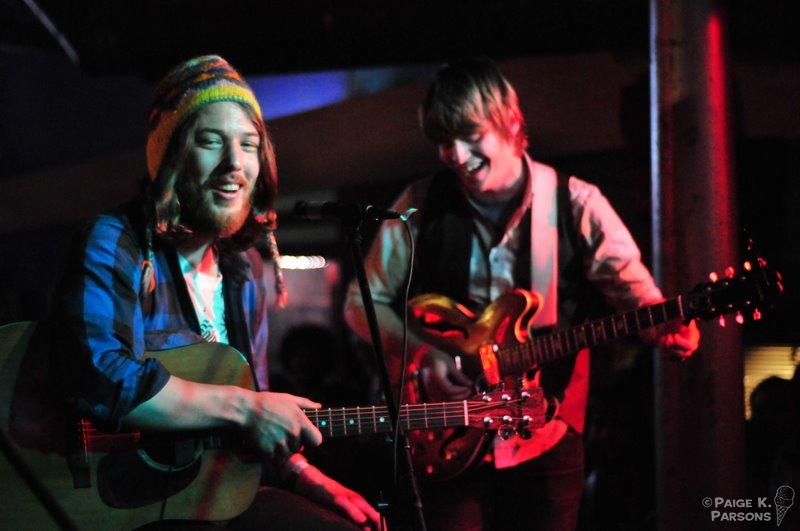
Robin Pecknold and Skylar Skjelset, Bottom of the Hill, Feb. 2008. Photo by Paige Parsons courtesy of The Ice Cream Man

Conceded: Fleet Foxes are not technically a “throwback,” per se. However, this is a blog about memory, and whilst sitting at my computer and stumbling through the internet abyss I came across a recording of the first Fleet Foxes show I ever attended courtesy of Wolfgang’s Vault. Talk about nostalgia in real time, this vault gives me the band banter and crowd chatter in addition to their set.

In 2008, the hither-to unknown Fleet Foxes opened for Blitzen Trapper at Bottom of the Hill during a local indie music festival called Noise Pop. I say “hither-to unknown” because this was their first out-of-town show; they hailed from Washington state. If you live in San Francisco and haven’t attended a Noise Pop festival, you should: the lineup always features a few stunners and the shows are staged in awesomely intimate venues scattered around the City. I was coaxed to the show by a friend who loves Blitzen Trapper, and dragged my heterosexual Lifemate with me. At the time I was painfully (painfully) single, and just young enough to foster the delusion that lead singers in bands were making eye contact with me.

We arrived at the venue early to survey and be surveyed, so we were front center when Fleet Foxes took the stage. Perhaps it was the second beer on an empty stomach, but this concert became a religious experience. For those unfamiliar with the venue, the stage at Bottom of the Hill is minuscule but has height to accommodate the storage of gear underneath it. These dimensions create an odd dynamic where the band feels accessible because they’re crammed onto a tiny stage, yet remote since they sort of overlord above you in an illusory command. Being front and center, we were gazing up into the lights when the fellas took the stage and, in that atmosphere, the flannel-wearing, long-haired Robin Pecknold looked like a modern-day Messiah. Please remember, I was somewhat intoxicated. Then the man opened his mouth and out came that folk hymnal mightiness that has driven this band into the limelight. Glory, glory, everyone.

After our communion with musical religiosity, the Lifemate and I moseyed over to the merchandise table which was manned by Fleet Fox Skylar Skjelset. Being awkward college co-eds, we fumbled to make conversation and what transpired is the reason why my memory of this concert (aside from the music) remains so fond. As we pawed at CD’s and records we had no intention of purchasing, Lifemate said to Skjelset, “Has anyone ever told you you look like Macaulay Culkin?”

Skjelset’s expression went from welcoming to deadpan and my inner monologue screamed “Uh, oh. Abort. ABORT.” He simply said no and then there was silence. So I jumped in with an uncomfortable giggle and the caveat that, sometimes, people just like to make celebrity associations. For instance, people often tell me I look like Kirsten Dunst. To which he replied, “At least Kirsten Dunst doesn’t look retarded.”

Having sufficiently slammed the door shut on that interaction, we moved on–specifically a few feet to the right in order to stay in close proximity to the band (cut us some slack, we were young). I went to grab another drink, and I returned to find Lifemate chatting up Josh Tillman. Sweet lord, she was on a roll. The point at which I entered the conversation, I heard him say “Oh yeah? What instrument do you play?” It should be noted that Lifemate does not, nor has she ever, played any instrument. Ever. Meaning she somehow either intimated mistakenly or blatantly lied to the fact that she was also a musician in order to find common ground. Excellent strategy; I think it unnecessary to elaborate on how that turned out.

To reiterate, we were incredibly young and intoxicated, and who hasn’t done some stupid stuff when those are the elements in play. For the record, I now KNOW through the wisdom of age that lead singers are not making eye contact with me except to acknowledge that I’m the girl that cold-emailed him/her about reviewing his/her show. Although it’s painful to recall growing pains, it’s also a delight to remember a time when possibilities were rife when you set foot into a venue–when every glance and every innuendo were titillating, and the music was all you had. I do take issue with the Wolfgang’s Vault for-profit model in which they market our memories to us, betting on the fact that we’ll subscribe to the soundtrack of our youth.

But…I am a subscriber. I am a subscriber because listening to the exact transcript of a show that partially inspired me to pursue music journalism is an out-of-body experience and is priceless. And that is the definition of a throwback.